Citation!

Just took a moment to Google my one peer-reviewed article, and learned that it was cited in the Supplementary Online Material to Chapter 3 of Knaust and Bromley’s (2012) “Trace Fossils as Indicators of Sedimentary Environments.”  It really is the little things in life that keep you going sometimes.

(Unfortunately, neither Knaust nor Bromley are on ResearchGate, which means I can’t tag their book as citing mine, but I’ll survive.)

Race Report: Dewey Du

Some cities have an established hometown marathon, some have a classic 10K, others have a “everyone can do it” bike race, and Grand Forks has the Dewey Kvidt Memorial Duathlon (now including a 5K/10K).  I don’t think I’m overstating my case by saying that it’s one race pretty much everyone can get behind–on the way home we even drove by a bar that had an advertisement up on the marquee.

Although the race started the year I moved to Grand Forks, this was only my second time competing.  It’s definitely been on the horizon and growing every year, spitting out some names you might recognize more recently from the Minnesota triathlon scene.  Last time I did the race, in 2011, I ended up fifth overall and, due to the no-double-dipping policy, third in my age group.

But let’s stop right there.  Do you really want to read about my training and my race?  I didn’t think so.

The Dewey Du is held in memory of Dewey Kvidt (who passed away in 2005) by his family.  It’s a testament to his love of sport that they even began to go through the trouble of organizing such a race, and have kept it going for so long (this was the eighth year).  This year was the first year starting from the Choice Health & Fitness Center in south Grand Forks, so it meant less indoor space for everyone and more exposure to the elements before the race.  You know what?  Nobody seemed to mind–7:45 AM, intermittent rain, 20+ MPH wind, and a bunch of us shivering under some large tents in the parking lot.  I’ve been to races with better weather and more miserable people; maybe we were all just glad it wasn’t snowing.

The run course was well-designed except for a few blind corners and one oblivious runner (me) who missed an obvious turn.  The 5K/10K began half an hour after the duathlon, which let all of us see who we were really racing against.  That wind was blowing from the north, and the bike route was an out-and-back…to the south.  Which meant 30 MPH out and 12 MPH back if you were one of the stronger riders.
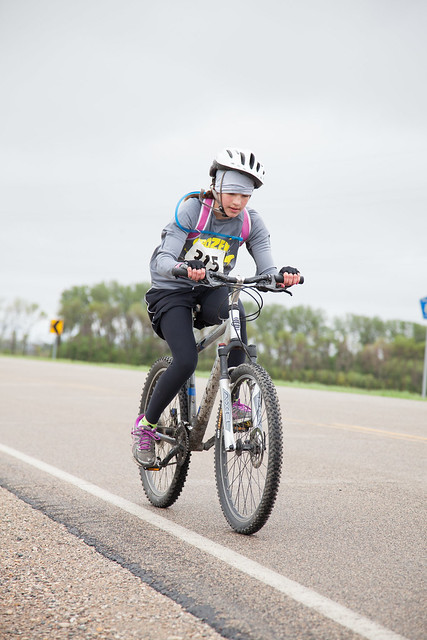
What’s that mean, anyway?  “Stronger riders.”  The fastest riders?  The riders able to snake in between the air molecules and eke out a little more speed?  I think we’ve got it wrong.  There were some physically powerful riders out there, but they may not have been the strongest.

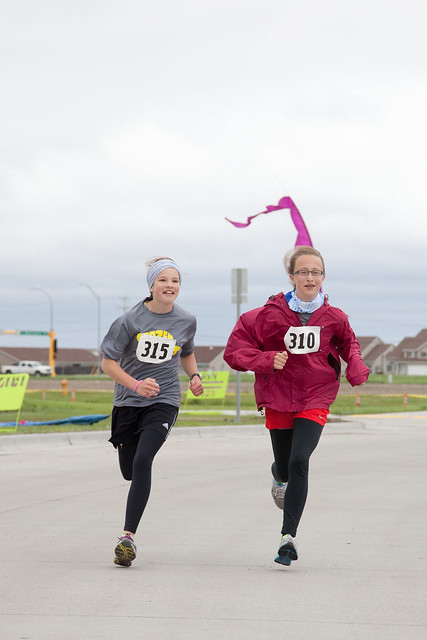
For the last few years, I’ve been involved in the organization Ground UP Adventures, the goal of which is to get youth into adventure-based activities.  Three of the youngsters who have been there from the beginning (back when the local youth climbing club first started) are Erin and Megan (sisters) and Lucy.  They’re 13, 11, and 13 (or so) respectively.  The reason I bring them up now is that they were there Saturday at the duathlon, not to cheer or compete as a team, but to each do the full race (5K/25K/5K).  They finished the race, on a day when riding into the wind was so tough that three or four miles an hour (what they could muster at times) was barely enough to keep upright.

They got up early enough to start a race at 8 AM on a Saturday.  They pushed through two 5Ks (the first of which they had ever done back in February), what must have been an excruciating bike ride, and what I find most impressive, two transition areas.  Two easy places to drop.  Two places to stop and relax (and there was cake!).  But they didn’t (you can check the results).  They kept moving and kept racing.  Megan came in from the bike leg, barely moving, and her only question was “Do I have time to finish?” before taking off like a rabbit. (I only wished I looked as fresh into my second run.)

I’m super impressed.  I’m writing all of this because you should be too.

I understand why we push kids into team sports (because it’s easy, because their friends are doing it, because it’s what we did), and I know these girls play soccer and volleyball and all those “regular” things.  They’ve done shorter adventure races on other youth teams and been successful.  But the thrill of being out there on your own, and it being you against the wind, and knowing you want to push as hard as you can with nobody else to fall back on, I think that’s important, and maybe they’re realizing that too.
All photos by Wes Peck.
Rail Studies

If you’re interested in having input into the future of rail in Grand Forks and how it will affect complete streets, please check out these topics at Engage the Forks:
– While planning for future freight rail access in the Grand Forks and East Grand Forks area, what are the key issues you believe should be considered?
– Along existing railroad tracks, where do you think the best site or sites would be for improved freight rail access in the Grand Forks and East Grand Forks area?

Hope to have more updates on this.

UPDATE:  Jason has an idea at http://www.engagetheforks.com/key-issues-in-freight-railway-access-planning/move-rail-yard-to-industrial-park

Looking for Collaborators

It’s been a while since I’ve put out an explicit call for other bloggers, so here it is!  This blog needs some fresh blood, new insights, and careful commentary on the state of the streets in the Grand Forks area.

To be clear:  You do not have to agree with me, with the complete streets movement, or with anything that has been previously posted.  If you live here, you have a valid viewpoint.

Drop a comment if you’re interested.  You’ll need a Gmail address to be able to post.  Post once or several times a week, it’s up to you.

-Matt

One Less Car

source

If you predominantly drive, you might take offense at stickers that say “One Less Car,” but that shouldn’t be the case.  “One Less Car” isn’t a comment on whether you should drive or not, or whether cars are good or bad.  Although reeking of smugness (and it is smug), it’s not being smug at your expense; think of it rather as someone saying “I’m doing my part, how about helping me out?”

For drivers, “One Less Car” means:

  • One less car between you and your destination
  • One less car to wait for at the next stoplight
  • One less car circling the parking lot and slowing you down
  • One less car using fuel and driving up the price for everyone else
  • One less car that can hit your kids as they cross the street
What makes me most sad about unthinking motorists is… If only they would think.
When I ride my bike, they’re not stuck behind a car. And when I divest of my car, because options like public transit, car sharing, Citi Bike and better biking/walking infrastructure… Well, that’s one fewer car competing for the alternate side free parking.
If only they would think.
If I were car dependent, I’d be falling all over myself to get my neighbors out of cars. More parking and less traffic for me!

Fewer cars on the road means happier people.  “One Less Car” means a better community.

Carbon Storage Value – What does it mean?


In case anyone else is wondering what “Carbon Storage Value” is, in relation to the $50 billion worth of trees in American cities, here is the explanation by Nowak et al. (2013):

To estimate monetary value associated with urban tree carbon storage and sequestration, carbon values are multiplied by $78.5 per tonne of carbon (range = $17.2-128.7 tC-1) based on the estimated social costs of carbon for 2010 with a 3% discount rate (Interagency Working Group, 2010).
 
I’ll have to dig a little more into the “estimated social costs of carbon,” but the detail of what that $50 billion number actually means seems to have been lost on many media outlets.
 

Photo by PhotoA.nl, CC.

GFK Traffic Death Memorials Formalized

Although roadside memorials have not reached epic proportions in Grand Forks (as far as I’ve seen), the city council today has approved a plan to formalize the memorial process:

For the [$30] fee, families would see a sign featuring a public service message such as “Please drive safely” or “don’t drink and drive” accompanied by their deceased family member’s name.
At least one person objected to the city continuing to allow roadside memorials in the city.
“I don’t think people of the city need to be reminded of an accident,” said an email from a resident read by council member Bret Weber.

As a complete streets advocate, I think these types of signs are the best way to remember someone who has died in traffic.  Each sign may help one more person to actually think before texting or drinking and driving, or be more vigilant.  It’s a far cry from enacting real complete streets legislation to improve safety for all road users, but anything to remind people of the “acceptable losses” we as a nation deal with every day is a good plan in my book.

Columbia Road Overpass Pedestrian and Cyclist Update

More straightforward news on pedestrian/cyclist access to the Columbia Road overpass during construction this summer:

Impact to Pedestrian & Bicycles from the Construction on Columbia Road 

 Have you been wondering how the road construction on South Columbia Road and DeMers Avenue will affect your non-motorized travel on the Columbia Road overpass? Here’s the good news: the overpass will be open for pedestrian, biking, and roller blading traffic during the beginning phases of the construction.

Here’s the bad news: access will not be available from South Columbia Road. If you are coming from the south, you will not have access to the overpass in the construction area. You will need use the DeMers Avenue trail and enter the ramp on the west side of Columbia Road. If you are coming from the north, you will not be able to access the trail south of the overpass. You must exit at the off-ramp on the south end of the overpass.

We’ll do our best to keep you posted on any changes to the pedestrian access to the overpass.

(via the latest Greenway update)

In fairness to anyone who will hop curbs and cross grass on a bicycle to continue traveling south, I think it will still be possible to get onto the hospital campus and continue south, but it is still unclear exactly what areas will become impassible during the construction.  We’ll do our best to let you know the best way to get through this mess as it changes this summer.