Kilimanjaro

This is actually something that I posted as a comment on another blog, but I thought it was worthwhile to post again:

My personal opinion is that we’re not going to destroy the world with what we do, but we should probably try not to (by curtailing ourselves from being overly destructive, etc.).

There is supposedly a paper that explains Kilimanjaro’s loss of glaciers as a result of deforestation. The loss of humid air rising up from the wooded slopes causes less condensation and deposition of ice on the cap of the mountain.

A paper in Nature is often (from what I’ve seen in my searches today) cited as the one that explains all this, but the Nature paper is actually a news summary of the work of Bill Ruddiman. I can’t pull up the references right now because UND doesn’t electronically subscribe to the journals in question.

I think this is probably a good answer to the question of Kilimanjaro, not because I’m skeptical of climate change but because the deforestation theory describes a discrete mechanism by which the ice cap would get smaller. It’s a lot easier to figure out whether a specific theory is correct or incorrect than to argue for or against such ill-defined terms as “climate change” that do not in themselves describe a mechanism.

Install GD library in Leopard

If you’ve been here before, note the heavy edits in italics. Read it all before you start doing funky things!.

I needed the GD library for my installation of The Ultimate Family Tree (TUFaT). It’s also needed for OpenX to be able to display graphcs.. For once, I found an excellent step-by-step tutorial on how to do this in the Moodle Documentation. Seriously, this was one of the easiest things I’ve ever done, and I even upgraded my PHP installation in the process. All the files are in the right place!

Just a note, that php.ini-recommended needs to be copied out, edited, renamed as php.ini, and then moved back for the final step.

Important: This blog post is also excellent and easy. It worked out for me when things didn’t work out (see below). Make sure to read the comments for some problems people have had. Here is another site that I didn’t use (because the last one worked).

Happiness!

EDIT: Not so much. For some reason, after doing this none of the applications I have can access the MySQL databases (Error #1045 – Access denied for user ‘root’@’localhost’ (using password: NO) ). Luckily (after giving up on finding an answer today), you can switch back to the default Leopard PHP installation by switching the commenting on those two lines in /etc/apache2/httpd.conf:

To use new PHP installation (above link):
#LoadModule php5_module libexec/apache2/libphp5.so
LoadModule php5_module local/php5/libphp5.so

To use old PHP installation:
LoadModule php5_module libexec/apache2/libphp5.so
#LoadModule php5_module local/php5/libphp5.so

When I find an answer to my problem, I will try to post it. Right now I am attempting to see how much the GD libraries are necessary for TUFaT.

Update: The solution to my problem was with PHP not really knowing where MySQL was, even though MySQL was on and working beautifully from the command line. I’ll copy it here from the comments on ‘phil has a blog’ (thanks mauricio)! Looking at this comment, it was actually posted only 9 hours ago, so that explains why I didn’t find it earlier this week!.

mauricio

After following all the steps described in the blog I had an issue making PHP & MySQL communicate.

After many trial an errors, lots of headaches, and many days with this machine down I found this post on another site. It solved my problem.

I had the same problem with MySQL getting no valid connection.
Code:
Warning: mysqli_connect() [function.mysqli-connect]: (28000/1045): Access denied for user ‘root’@’localhost’ (using password: YES) in

With my default MySQL and PHP installation in Mac OS X 10.5.2 there are no problems with the connection.

In my opinon it’s caused in this parameters from the compilation:
Code:
‘–with-mysql=shared,/usr/local/php5’ ‘–with-mysqli=shared,/usr/local/php5/bin/mysql_config’ ‘–with-pdo-mysql=shared,/usr/local/php5’

With those configurations PHP searches for the MySQL lib inside of the PHP5 path.
My solution was:
Code:

cd /usr/local/php5/lib
sudo mv mysql mysql.old
sudo ln -s /usr/local/mysql/lib mysql

restart apache

Using ImageJ for what tpsDig does, but on a Mac

If I had discovered this months ago, my thesis would probably be in a much better position right now! I’ve been tied to the PC in my office, rather than being able to go home and watch movies or TV shows while I did my digitizing.

The free program ImageJ is useful for all sorts of things, like processing images for analysis and doing measurements on photographs, but it can also record coordinate (x,y) pairs as an output file, which is perfect for digitizing specimen outlines for later Elliptical Fourier Analysis.

I have been using tpsDig by F. James Rohlf for this, and I’ve never seen an alternative mentioned, probably because most of the other software written for geometric morphometrics is written for DOS and Windows.

Enough blabbering, here’s how to do it:
1. Start ImageJ. Open the image you want to outline.
2. Important! Make sure the coordinate system being used is the same as that in tpsDig (tpsDig places the origin in the lower left, ImageJ in the upper left by default). Select Analyze->Set Measurements…->Invert Y Coordinates.
3. Select the “Polygon Selections” tool on the floating toolbar. [If you’re really good, you could also use the “Freehand Selections” tool and get out scads of numbers.]
4. Outline the object by clicking along the edge of the object. When you close, double click to stop the digitization.
5. Choose File->Save As->XY Coordinates and save your file.
6. You’re done!

To get this to be readable by tpsDig and related software, you will obviously have to add the top three lines that describe the file, the number of landmarks, and the number of curves, as well as the name of the image file as the last line in the file. I don’t have a present need for that, but it’s not too hard to write up an R function (or a terminal script) to add lines (interestingly enough, I’ve been using sed to do this in DOS batch files recently rather than the OS X terminal).

UPDATE: Somewhat annoyingly, ImageJ seems to only open JPG files in RGB colors, not in CMYK. I have no idea why. Luckily, this comes at a time when I am only first starting to realize that CMYK is a more standard color choice than RGB, so most of my files are still in RGB.

If scaling is a factor (it is for me), you can install the Zoom_Exact plugin (near the bottom of the page). Installing this was interesting, but the documentation helped somewhat. What you want to do is:
1. Choose Plugins->New…,
2. Select type “Plugin” and name it “Zoom_Exact”
3. Paste the code into the boz that appears and save it as “Zoom_Exact.java”
4. Restart ImageJ. “Zoom Exact” should appear at the bottom of the Plugins menu.
5. To easily use Zoom Exact, you can map it to a shortcut key with Plugins->Shortcut->Create Shortcut. I have mine mapped to capital “Z” so I can call it up easily when I want to get the scaling right on the screen.

Schools

I’ve been reading the comments to this blog post by an inner-city teacher for the last few days. The major discussion is about whether or not it is right to separate students who care about their education from those who do not want to be in school. Good points have been made on both sides, but the excerpt below (from comment 126) really makes sense to me.
 

Charter Schools aren’t always the answer. Children who have experienced gun violence, house fires, abusive parents, gangs, hunger – are not going to be able to learn whether they are in a charter school or public school.

We need to declare war on the inner city – not Iraq. We need to make our children safe, warm and nourished if they are to succeed in school.

The first step towards having an educated populace is making that populace feel that they can get an education safely. This is an American freedom: are the kids and adults in the inner city able to achieve life, liberty, and the pursuit of happiness? Or are they limited by the devastation they see around them every day? If you don’t see anyone around you achieving anything, it makes you think nothing can be achieved.

We should declare war on the inner city. We should make the entire country safe for our children. I can’t see any argument against this–when we have problems like this in our own country (people losing faith in the economy, people losing faith in the public schools, people losing faith in themselves, people losing faith in students because of how they act), we should act to fix them. This means eliminating gang violence. This means eliminating any sort of criminal activity.

It also means more investment in education. It means offering courses (with childcare) for people who never finished high school. It means engaging the youth before they decide that hanging out on the street corner is more exciting than Edgar Allen Poe, mitochondria, or astronomy.

Destroying the inner city means making people proud of where they live, not because it makes them tough but because it’s their home. It means enforcing building codes and keeping street lights prepared [In good repair?  2014-02-07]. It means making sure that our police force is synonymous with honesty and integrity, not with power and corruption.

This will take time, and it will take money. I for one am willing to donate that time (by volunteering and teaching) and money (yes, even if it means a tax increase) if we can build a country where everyone is free, everyone can feel safe, and everyone can get an education regardless of their circumstance.

UPDATE: Thomas Friedman is saying the same thing.


R and installing mvtnorm

Just a note, since I had to figure it out.

Mac OS X Tiger PPC, R 2.6.1

To load the ICSNP library in R, you need to install the mvtnorm package. The package installer for some reason would not do this, but you can download the binary from this page and install it with Packages & Data -> Package Installer -> Local Binary Package (under “Packages Repository”) and click Install, which will let you grab the package from the place to which you downloaded it.

UNIO listserv/mailing list

Since I just spent a little while tracking this information down I figured it would be useful for people to know.

The UNIO mailing list, devoted to the discussion of unionid mussels, seems to no longer have a home page that describes how to subscribe or unsubscribe. One can, however, go through the Listserv software at the Florida Institute of Technology.

List homepage: https://lists.fit.edu/sympa/info/unio

To subscribe: Send an email to sympa@lists.fit.edu with no subject and this line only in the body of the message:
subscribe UNIO your-email-here

To unsubscribe, I suppose you would do the same, substituting “unsubscribe” for “subscribe.”

Happy hunting!

Grad School, some more

I was going to sit down and write about how I was inspired to write again by this post by YoungFemaleScientist, but then people came into the computer lab, my papers finished printing, and now it seems like I’m wasting time again.

I don’t think I am though. I don’t take enough time to write anymore, either by blogging or in a notebook, and it’s at this point that things fall through the cracks. I’ve been doing more work lately with my thesis, which is great, but I’ve also been doing some super-secret coding for a website that may or may not last in the long run. Through it all, I keep avoiding doing the thing that may most help me out, which is to read some more articles and write a paper that is unrelated to my current thesis but is probably more important to get out there. It either gets buried in doing thesis work (#1 priority), spending time with the girl (of course, also #1 priority) and working on this website (#2 or 3 priority).

I’m being circumspect because I’m becoming too public of a person and I want to stop it. I may just start the blog over with a fresh mindset and be able to freely blog about things without having to think about how what I write can be connected to other things I have written or said. People manage to have wonderfully open and professional blogs and stll admit who they really are, but I’m not sure I can do that with the history of this blog the way it is (through high school, through college, etc.) It’s a weird feeling thinking that if someone wanted to find out about me, they could search back through this blog and then hold me to things I said or ideas I had when I was in high school [Interestingly enough, even before I moved some (but not all) of my previous blogging from Blogspot to Drupal, I had cleaned out what must have been a substantial number of posts from before 2004.  I’ll have to dig around my computer and see if I still have them somewhere. 2014-02-04]. Maybe I should leave it all up as a monument to how much a person can change though.

For today, however, I am going to focus more on what’s important to get done–real research before computers, real teaching before fun, and sending my grandmother her birthday card before I forget. These are the important things.

Cleaning and Eyes

Don’t worry, I didn’t splash cleaning fluid in my eyes this morning.

For anyone who doesn’t know me (read: all of you), I can be sort of anal at times. I know, this is shocking, but true. I’m trying to repress it, but mostly it comes down to people being polite less often then they should be. (This would be a good time to talk about my differentiation between wanting to be nice to people for PC reasons and wanting to be nice to them just because, well, it’s nice. But I’m already combining two topics today, so you have to wait.) I have to be honest here, I’m not a cleanfreak (neatfreak, sometimes, but even that is being whittled away over time as I get busier) but I do like things to be relatively clean and free of the largest clumps of dirt and dust. My roommates in the townhouse senior year may think I’m the filthiest thing ever since I would let two weeks go by before cleaning the bathroom, but what can you expect when you live with four girls? (Note to self: never live with four girls again.) I sweep my place and wash what’s needed and have done with it.

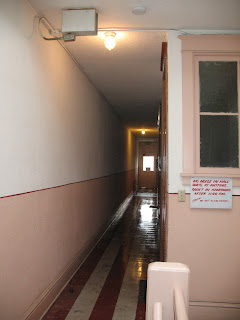
Anyway, since I’m being paid back $100 a month to keep the apartment building hallway relatively clean and vomit-free, today I swept and mopped.

I try to do this on a regular basis, which probably averages out to once every two weeks and should probably be every week, but hey, I’ve got things to do. In any case, I returned from vacation last night to find the hallway full of more dirt than I thought would be able to accumulate (but luckily no vomit). I really don’t understand how three weeks of walking in and out of a building could produce this much dirt, but it did. I can deal with the dirt–a little sweeping, a little mopping, no big deal. Thing is, I also had to sweep up cigarette butts, bottle caps, an empty beer bottle, chunks of cardboard, and random other crap. What’s the deal here? Have people become so idiotic to totally trash the place they live? Granted these aren’t the nicest apartments in town, but they serve well, are warm in the wintertime, and with a little decorating can be made look nearly as nice as everywhere else. So why would you, no matter how drunk, toss your crap in the hallway as you came in or out of your apartment? If you’re bringing a girl (or guy) over and want to make an impression, is the impression that you live in the ghetto really the one you want to make?

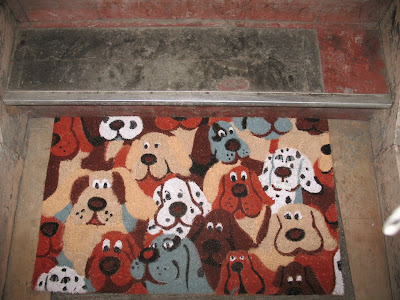
The question is, how to fix this problem? We can call it a problem because it creates more work for me when people throw their crap everywhere and don’t think anything about it. I could go and talk to people about it, but a) I don’t feel like it, b) I don’t know when everyone is home and c) judging by some of the people who live here, it might create more of a mess out of spite. So what to do? I was planning on getting a couple doormats when I go out next to catch dirt when it comes in the building, and if possible I wanted them to say something like “Wipe your feet!” on them. Then I got to thinking: this is so obvious, is there a more subversive way to deal with it? Of course there is! It may not work as planned, but it should be interesting to try.

According to this paper in Science, the sense of someone watching you (in animals and humans) induces altruistic behavior. This can be seen in fish and birds, but also in humans. A “donation box” with eye-shapes (dark pupil surrounded by white sclera) on it supposedly gets more donations than one without the eyes because of the sense of being watched. Could this be my solution? Is keeping the place clean enhanced by putting down doormats with eyes on them? Would putting eyes on a bar of soap or a bottle of shampoo make you wash yourself more seriously? I wonder how the eyes are associated with the object?

I’m interested in trying this out. I may not be able to find doormats with eyes, but I could surely paint some on to see if my scheme works.

UPDATE: Here is the doormat. I’m pretty sure it is not having the desired effect, but it is better at trapping dirt than the one that was there before.