Life as a Race/Event Coordinator

I was recently (last month) elected to be the Race/Event Coordinator for the UND Cycling Club. This is a position I’ve more-or-less held in some capacity for the past few years, since I’ve been trying to get more events happening ever since I got hooked up with the club back in 2008. Now that I can someday put this on my resume (ha!), I’m taking it more seriously, but at this point I’m receiving more help than opposition than any time in the past.

I intend to add “event coordinating” to the list of things I blog about here. Over the next year you will be subjected to the problems I encounter, the triumphs of successfully navigated paperwork, and hopefully even some good feedback about what else can be done in Grand Forks for this organization and others.

One of my inspirations in this pursuit is Andy Magness, director of END Racing, choreographer of the only adventure racing in the state, and top-notch yoga instructor. If I can get to the point where I can orchestrate an event with half the participants, half the sponsors, half the press, and half the general excitement surrounding it of any of the events Andy has organized over the last few years, I’ll be flying high.

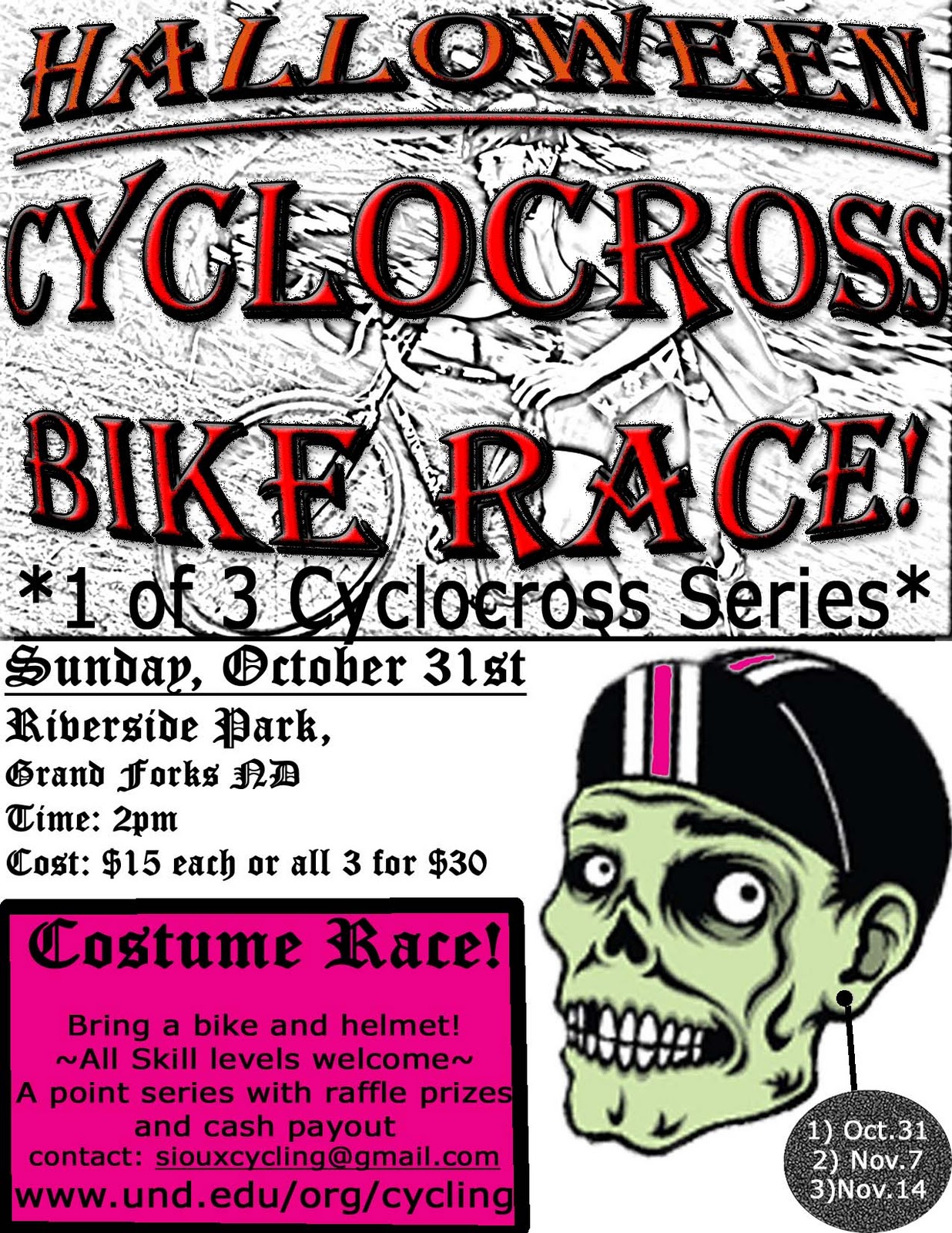
As someone who is naturally not outgoing, event coordinating is a big deal to me for that reason: I have to interact with people, I have to know what’s going on, and I have to think of things nobody else does, answer questions that nobody would ever come up with, and do it all with volunteers who would much rather be racing than volunteering (but we’re working on that this year; I’m committed to this role, even if it means I don’t get to participate in the ‘cross series [beginning Halloween in Riverside Park], the icebike series [announcement coming soon!], or even another collegiate road race weekend).

Most importantly, I need to be able to take the (sometimes nebulous) ideas presented by club members and turn them into a workable event. The best mind we’ve had for this is Dave Cardarelli, who will finally be graduating this December. Whether we’ve been organizing UND’s 2010 NCCCC road race weekend (complete with conference criterium championships), alleycat races that aren’t boring, or Grand Forks’ first ever (?) icebike race, Dave has either known what to do or shouted the rest of us down when we disagreed, which generally amounts to the same thing. Now that I’ve got this role on my shoulders, I hope I can measure up.

So far this fall I’ve been in contact with more people than ever to get some last-minute fall events into place and think about the future:

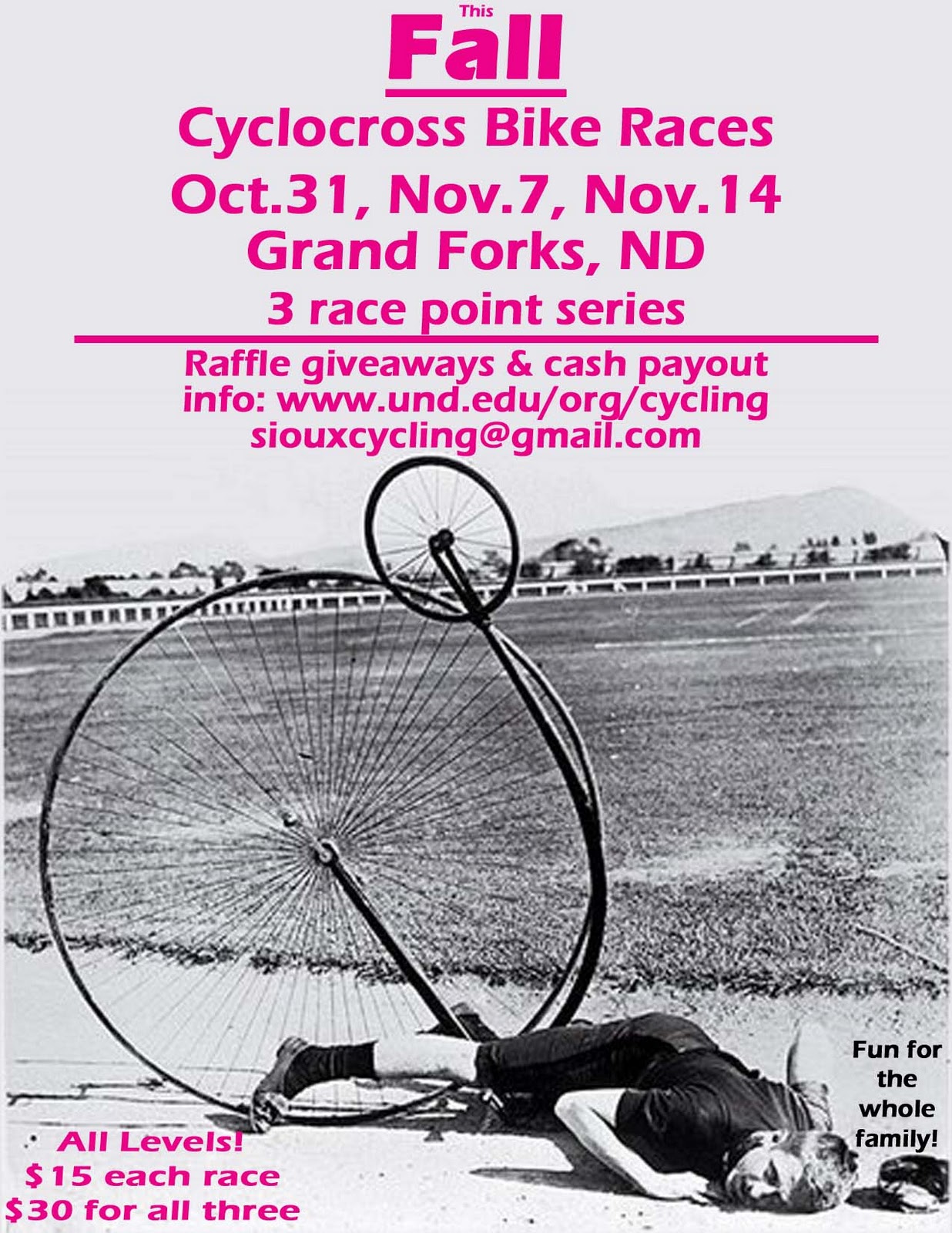
  • We’re starting a three-race cyclocross series (UND’s Fall Classic, to be expanded next year) on Halloween. Instrumental in the planning of this race so far have been my geology colleague Ted Bibby as well as Dave; so much so that I have yet to visit they race course they’ve supposedly devised, even though I’ve delivered a map to the city with our request for a special events permit.
  • For the long term, I’ve been working with riders in Fargo, Sioux Falls, and Winnipeg to organize a winter icebike series next February, as well as keeping in contact with Andy Magness to make sure we won’t interfere with END-IT (which as scheduled stands to be the light at the end of the tunnel of a month of winter racing if all goes to plan).
  • It hasn’t been nailed down yet whether we’ll be hosting “Too Flat, Too Furious” again next spring, but if our roster expands as much as I hope it will, we shouldn’t have a reason not to (more riders, in my mind, means a larger volunteer pool and more people invested in making sure the event goes off without a hitch). We’ll be talking about this down the road as people start dropping like flies around January.
  • We failed to organize a late summer mountain bike series this year (although getting a ‘cross series in before the snow is a nice bonus), but I hope to get it rolling for sure in mid-August: six weeks of mountain bike racing at Turtle River State Park followed by six weeks of cyclocross (which could alternate between TRSP and the Grand Forks Greenway, to say nothing of finding a friendly farmer who will let us use a cornfield).
  • Beyond? Well, let’s not get ahead of ourselves 🙂

As a final note, this isn’t about me: it’s about the club and what we can do for people in Grand Forks. Cycling, running, and even adventure racing events have been on the rise since I moved here in January 2006. I intend to make this trend continue, so if you have any ideas for events, improving events, or collaborating, get in touch.


ND EPSCoR State Conference 2010 in Grand Forks

I spent this morning and early afternoon at the North Dakota EPSCoR 2010 State Conference. EPSCoR (Experimental Program to Stimulate Competitive Research) is a federally funded program to fund states that need additional infrastructure in order to improve their research output. It is funded competitively, and then those funds are distributed within the state towards research projects, facilities, and scholarships. I learned today that North Dakota is the only state that has been funded continuously since the program’s inception in the early 80s. Part of this is supposedly because the state agrees up front beforehand to match the federal money given, something I guess other states aren’t able to do.

The posters (graduate student research projects) were generally very good, although a lot of walking was involved to see everything because of placement on the walls down the main corridor of the Alerus Center. Several of my Geology and Geological Engineering colleagues presented posters, most of them luckily in high-traffic areas. A lot of the material was biochemical in nature, which tended to make me (since I’m not a chemical biologist) gloss over some things I probably shouldn’t have; I would suggest to EPSCoR that in the future the posters be arranged more according to topic, which might have the added benefit of getting students from different institutions to talk to each other about their similar topics.

I’ve scanned the poster session program (includes abstracts), and for general entertainment I shot some photos, shared below.

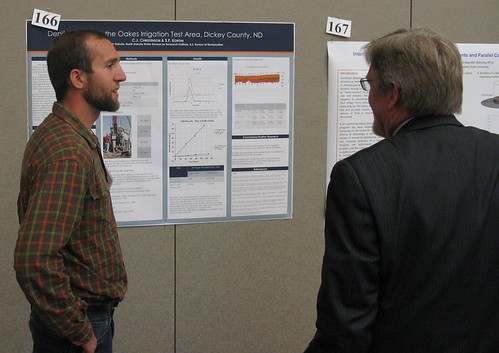
IMG_7323 crop
A geologist explains his project.
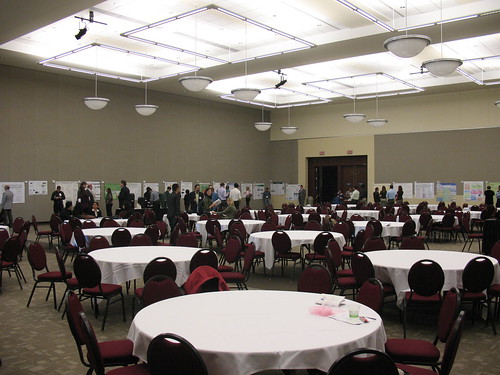
IMG_7326
Breakfast, the introductory speaker, and some of the many posters were on display in this room.

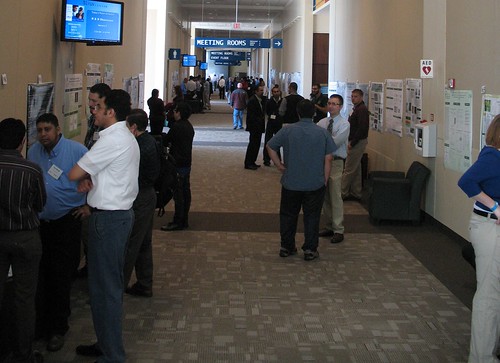
IMG_7336 crop
Student posters went all the way down the hall.
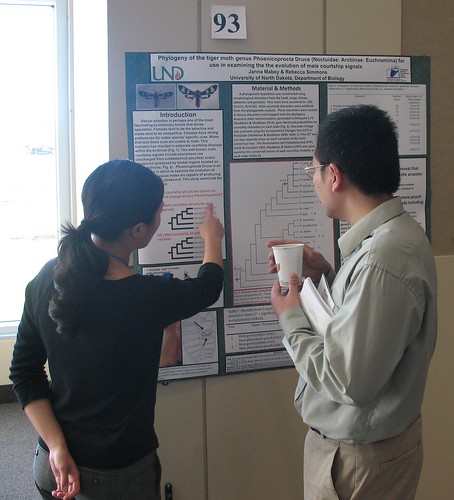
IMG_7338 crop
A biologist explains her work.
IMG_7346
Lunch was surprisingly good for being free.


To do: make sure I have a list here of all the GGE students who presented.

Interesting Statistics [College Athletics]

At the moment, I’m attending the University of North Dakota, which is currently in the process of moving into NCAA Division I for some unknown reason. I went to undergrad at St. Lawrence University, which is Division III in everything but hockey. Now I know it’s sometimes ludicrous to compare the two, but I found out some interesting things from the Office of Postsecondary Education website.

Undergrad Enrollment (here’s the big difference):
SLU: 2,111
UND: 12,833

Unduplicated Athletic Participants (men and women):
SLU: 636
UND: 447

Already, this begins to look interesting. SLU has more students involved in intercollegiate athletics, TOTAL. If we take that to percents of total undergrads, we get:
SLU: 30%
UND: 3%

Yes, only 3% of UND students are involved in intercollegiate athletics! I don’t know how this stacks up against other schools, but to me that seems really, really low for all the hype that surrounds them.

If we look at the money (and this is the weird part), we get expenses like this:
Total Athletic Expenses:
SLU: $5,616,179
UND: $11,250,249

And we get revenue like this:
Total Athletic Revenue:
SLU: $5,616,179
UND: $11,414,689

I’m not sure why SLU’s net balance comes out to be $0. It might be something to do with losing money on teams (maybe since they have to pay for it somehow, they can’t have a negative balance?). UND’s balance is a shocker: Apparently the school made $164,440 dollars last year on athletics.

I admit that I’m a little biased against UND already for putting so much money into athletics to serve a whopping 3% of the undergraduate student body, but did they really make a profit? Will this continue when they have DI bills to pay? Something tells me that the switch to DI is going to cost more than $164,440 per year.

You might wonder why I don’t give SLU a hard time about not making a profit at all in athletics. I have to ask you this–are athletics for the students, or for the university? There is a lot of money flowing through SLU, and if some of it can be used for athletics to keep the athletes happy, I can live with that. Not so with a school at which only 3% of the undergraduates are part of the athletic program.

UPDATE: I’ve been discussing this in the City Beat blog comments.