Union Relationships

I’m reading The Hammer by Hamilton Nolan and got curious about how my local union relates to national groups.

North Dakota United

North Dakota United (NDU) was created in 2013 as a result of a merger between the North Dakota Education Association (NDEA) and the North Dakota Public Employees Association (NDPEA).

NDU is a state affiliate of the National Education Association and the American Federation of Teachers.

National Education Association

the largest labor union in the United States (Wikipedia)

American Federation of Teachers

The largest unions currently in the AFL-CIO [include the] American Federation of Teachers (AFT). (Wikipedia)

Apparently NEA and AFT are two “competing” unions with slightly different philosophies: https://en.wikipedia.org/wiki/National_Education_Association#Relations_with_the_American_Federation_of_Teachers

AFL-CIO (American Federation of Labor and Congress of Industrial Organizations)

the largest federation of unions in the United States (Wikipedia)


I’m still confused about locals and chapters. Not sure what the organizational structure is, for example, at UND.

Some things that have come up in searches are below. I will update if I find more. If unions are going to grow, they’re going to need more than Facebook pages.

  • UND United, AFT #6942 on Facebook
  • North Dakota Public Employees, Local #4660 on Facebook

More Parking “Fun” at UND

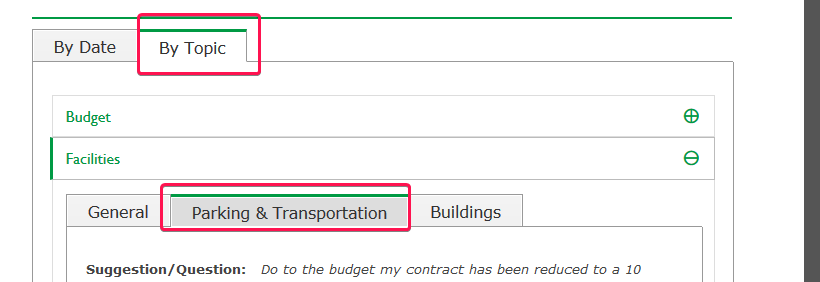
If you want to see some of the suggestions by staff about parking on campus, look no further! Head to the Staff Senate suggestion box and click “By Topic,” “Facilities,” and then “Parking & Transportation.”

Screenshot of a web page showing where you should click.

I’d like to suggest some more about promoting walking, cycling, and transit, but I doubt these ideas will be taken seriously unless I show up to the next open forum.

Edited to add an email with more information about the upcoming parking process:

Open forums will be held March 25 and April 15 to seek input from students, faculty and staff regarding UND Parking and Transportation planning and possible changes. All are welcome.

  • Monday, March 25, 9:30-10:30 a.m., Memorial Union Lecture Bowl
  • Monday, April 15, 3-4 p.m., Memorial Union Lecture Bowl

Following is some background information about the proposed changes. Please note that final decisions on parking and transportation have not yet been made. More information will be provided when it is available.

Why are parking and transportation changes being considered?

UND Parking must become self-supporting within the next five years, and will no longer receive state funds beginning in 2024. All costs and expenses related to parking must be covered through permit sales and parking fees.

Currently, parking is partially subsidized from other sources, and that support will no longer be available. Parking permits and fees must provide enough revenue to operate, maintain, and develop parking lots and spaces. One goal of the new model is dedicate funds for parking lot maintenance and construction.

How is the parking policy being developed?

Members of the Parking Committee have been meeting regularly to develop a new plan for parking. The forums will gather input from students, faculty and staff. Parking recommendations will be finalized in May and sent to Vice President for Finance & Operations Jed Shivers for review. After review, the new parking structure will begin operating Aug. 1.

What changes are being considered?

One of the unique challenges faced by Parking Services is that nearly everyone uses parking. And as much as we would like to, not everyone can park at the front door.

Parking revolves around three factors: cost, convenience and supply. Everyone would like parking to be convenient, inexpensive and sufficient, but that’s not possible. If parking is inexpensive and convenient, it will not be sufficient. If there is sufficient and inexpensive parking, it will not be convenient. And if there is sufficient and convenient parking, it will be expensive.

Parking fees will likely be raised to cover parking costs. Instead of zones, parking may be “tiered,” or have different costs according to location. And parking spaces may be shared. For example, 100 people can generally share 60 to 80 spaces, since not everyone is on campus at the same time. Parking fees may differ by location and use.

Shuttle bus services may offer additional routes to transport people from more distant lots. Those lots will have lower parking rates. Shuttle bus services may also be adjusted.

When will the changes take place?

No final decision has been made. If the recommendations are approved, they will go into effect on Aug. 1.

Quickly access journal PDFs for which UND has a subscription

If you're using Google or another engine to search online for journal articles, seven times out of ten you'll end up at the site where you can get the PDF (via institutional subscription) but you won't be recognized as the institution.  This also will happen if you are off-campus.  One way to get access is to head back to the UND Libraries site, find the eJournal search, type the name, and then navigate to the right issue.  There is a better way.

Take this URL for example.  I wound up here after Googling for one of the authors and looking for his email address:

http://jgs.geoscienceworld.org/content/163/4/707.abstract

In order to get that PDF (or see if we even have access), just add the UND proxy to the middle of the URL (bolded for convenience):

http://jgs.geoscienceworld.org.ezproxy.library.und.edu/content/163/4/707.abstract

You'll get bumped to the UND Libraries off-campus login page, and then back to the article page when you've logged in.  Now if you click on the PDF link, you'll find out whether we have subscription access (the PDF will open) or not (you'll hit a paywall).  This has worked well for me for the past year or so.

Quickie: Dakota Student and Sidewalks

This editorial in the Dakota Student is from back in April, but it suggests one more way in which UND and Grand Forks can agree on something in the future–if both entities agree to create a unified complete streets transportation policy.

The thought arises at a moment such as this as to the importance of sidewalk maintenance and safety. Obviously the road is worthy of cars and loading trucks, but when was the last time the cobblestones were inspected or fixed? This area might not be used for car travel, but students consistently navigate these regions.

Not something you would typically expect from a student newspaper, is it?

Closing University Avenue

One of the best things about going to a small residential university for my undergraduate degree was the lack of cars on campus.  The campus was small, there were parking lots on the outskirts (near most of the dorms), and you walked or rode a bicycle everywhere.  It was a given.  The campus was small enough to make this feasible.  It’s not that there were no vehicles at all–delivery trucks and the like would drive through in the early morning, the streets were plowed during the winter, and on move-in and move-out day you could bring your vehicle in to move your stuff–but for the students, we just had to deal with the lack of motorized transportation.

The Grand Forks/East Grand Forks Metropolitan Planning Organization is looking to do a similar thing for part of the University of North Dakota, reports the Grand Forks Herald.  They have released a report (which I have not located yet) proposing the closing of University Avenue between Columbia Road to the east and Stanford Road to the west (see image from the Herald website) in order to reduce pedestrian/motorist interactions, promote walking and cycling, and reduce emissions from motor vehicles.

Image from the Grand Forks Herald.

This proposal is notable for its daring and progressiveness.  This might be the first instance of closing streets for the sake of pedestrians in Grand Forks history.  There are strong criticisms, however I think they can be mitigated.  Two in particular stand out: emergency vehicle access and perceived increased congestion.

Emergency vehicle access worries are due to the use of University Ave as a route for fire trucks and ambulances, but “closed to personal vehicles” does not mean “closed to emergency vehicles.”  Allowing these vehicles access to University Ave, as long as even one lane is left clear for service, might even decrease response times due to not having to wait for automobile traffic to get out of the way.

Perceived congestion is a more difficult nut to crack, but I propose an initial tradeoff to help people understand the value of this street closure: limited hours of operation.  Larger cities do this all the time–drive into Washington, D.C. some morning and you’ll see whole residential streets change one-way direction–and people learn how it works.  Close University Avenue between 8 AM and 4 PM every day (perhaps with gates) except to service and emergency vehicles for a trial semester, study the effects, and use those data to shut it down completely.

Again, I’m very excited about this plan because it opens up new possibilities.  Street parties.  Street vendors (allowing off-campus restaurants to set up shop for lunch).  More space for people on foot and bicycles.  Less noise, traffic, and emissions for everyone.  What other opportunities do you see?
 

[activity] Teaching Geology 101 Lab this summer

I will be teaching a lab section of Geology 101 (Introduction to Physical Geology) at the University of North Dakota for the first summer section (16 May to 24 June). We (the instructors) are earning pretty much the minimum possible in order to have the class with so few students, but it should be a worthwhile experience.

[activity] 2011 UND Scholarly Forum

Presented a poster during the 2011 UND Scholarly Forum, hosted by the Graduate School at UND.

BURTON-KELLY, M.E., J.H. HARTMAN, and A.E. BOGAN. 2011. Determining temporal and geographic limits of fossil freshwater mussels of the family Hyriidae. The Graduate School Scholarly Forum, March 8 – 9, 2011, University of North Dakota, Grand Forks, North Dakota, USA, p. 73. Abstract and poster PDF 9.5MB

There were only three of us from Geology and Geological Engineering, so next year we’ll have to represent better.

Trying to Focus on Specimen Databasing

This post will explore some fairly specific topics, but I hope the thought process will be instructional (or inspiring) to others. Additionally I think it’s worthwhile to talk about the concepts of specimen/biological collection database management with reference to funding, not schemas and platforms.

At the UND Department of Geology and Geological Engineering, a small number of us have been pursuing an overall upgrade of the paleontological specimen and lithotype collection consisting of improved facilities (compactor cabinets) and a comprehensive online database. We’ve applied for funding from NSF and been denied twice, and the project would be dead in the water except for the quarter-time assistantship I’m receiving from the Dean’s office at the School of Engineering and Mines. Development has been slow, mostly due to the conversion between the existing databases (stored as flat text files) and the online system (I will not mention the name of the new system because events today have made me question (again) the cost/benefit ratio of utilizing it), and I’ve been importing locality data so we can use the new system to analyze locality distribution, among other things.

The question today is how to proceed. As useful as locality data are to paleontological and geological researchers, locality information is, at its core, supplementary to the specimens themselves. (I’ll avoid an argument right here: I believe that locality data are essential to proper context, and I’m not advocating the dissociation of these data from specimens.) Specimens are the core of the paleontological sciences, and it is from specimens and their assigned taxonomic identities that researchers work toward understanding past life. Rather than browsing locality lists and then looking at specimens, given a database most researchers will search by taxon or in special cases by specimen number, and then they will look at the associated locality data. In my opinion, we’ve been doing it wrong.

The above point regards usability, and I promised to talk about funding issues, so here we go: in order for such an online database (and more importantly, the effort to digitize specimen data and provide specimen imagery) to keep getting funding, it needs to be usable so it will be used! That’s the whole point. If the Dean (or any other UND administrator) wants to put us on the map for having a world-class collection, we need to get the data out there that people want, we need to tell them about it, and we need to encourage them to use it. From the administration’s perspective, numbers are going to determine how successful we are: number of unique visitors the online database gets every year, number of publications that reference specimens held in our collections, and number of researchers who visit or request material loans.

What can I do today that will improve our chances? In my opinion, we need to improve usability by others before we can improve usability by ourselves. This means a focus on specimen-data entry, the postponement of certain analytical capabilities we (as UND researchers) would like, and beginning with those specimens referenced in peer-reviewed articles, dissertations, and theses. These specimens have already gotten the most attention and they are likely to get more attention in the future because of their “published” status. The associated material can come next, and then we can start adding data systematically. At this point, to show that this is possible and that it shows our research collections in a good light, we need to get the bare bones online first and follow with everything else later.

That’s what I think, and what I will discuss with others here later today. Has anyone else come across such a crux of funding issues? How about with specimen collections that are even less sexy than ours (which are primarily freshwater mollusks, and are pretty darn sexy in my opinion)? Am I on the right track, or should we back this train up again?