Trying to Focus on Specimen Databasing

This post will explore some fairly specific topics, but I hope the thought process will be instructional (or inspiring) to others. Additionally I think it’s worthwhile to talk about the concepts of specimen/biological collection database management with reference to funding, not schemas and platforms.

At the UND Department of Geology and Geological Engineering, a small number of us have been pursuing an overall upgrade of the paleontological specimen and lithotype collection consisting of improved facilities (compactor cabinets) and a comprehensive online database. We’ve applied for funding from NSF and been denied twice, and the project would be dead in the water except for the quarter-time assistantship I’m receiving from the Dean’s office at the School of Engineering and Mines. Development has been slow, mostly due to the conversion between the existing databases (stored as flat text files) and the online system (I will not mention the name of the new system because events today have made me question (again) the cost/benefit ratio of utilizing it), and I’ve been importing locality data so we can use the new system to analyze locality distribution, among other things.

The question today is how to proceed. As useful as locality data are to paleontological and geological researchers, locality information is, at its core, supplementary to the specimens themselves. (I’ll avoid an argument right here: I believe that locality data are essential to proper context, and I’m not advocating the dissociation of these data from specimens.) Specimens are the core of the paleontological sciences, and it is from specimens and their assigned taxonomic identities that researchers work toward understanding past life. Rather than browsing locality lists and then looking at specimens, given a database most researchers will search by taxon or in special cases by specimen number, and then they will look at the associated locality data. In my opinion, we’ve been doing it wrong.

The above point regards usability, and I promised to talk about funding issues, so here we go: in order for such an online database (and more importantly, the effort to digitize specimen data and provide specimen imagery) to keep getting funding, it needs to be usable so it will be used! That’s the whole point. If the Dean (or any other UND administrator) wants to put us on the map for having a world-class collection, we need to get the data out there that people want, we need to tell them about it, and we need to encourage them to use it. From the administration’s perspective, numbers are going to determine how successful we are: number of unique visitors the online database gets every year, number of publications that reference specimens held in our collections, and number of researchers who visit or request material loans.

What can I do today that will improve our chances? In my opinion, we need to improve usability by others before we can improve usability by ourselves. This means a focus on specimen-data entry, the postponement of certain analytical capabilities we (as UND researchers) would like, and beginning with those specimens referenced in peer-reviewed articles, dissertations, and theses. These specimens have already gotten the most attention and they are likely to get more attention in the future because of their “published” status. The associated material can come next, and then we can start adding data systematically. At this point, to show that this is possible and that it shows our research collections in a good light, we need to get the bare bones online first and follow with everything else later.

That’s what I think, and what I will discuss with others here later today. Has anyone else come across such a crux of funding issues? How about with specimen collections that are even less sexy than ours (which are primarily freshwater mollusks, and are pretty darn sexy in my opinion)? Am I on the right track, or should we back this train up again?
Things It Would Be Great To See Finished (part 1) – Bicycle Routing Map for GFK

I’m always trying to organize myself a little bit more. Unfortunately, this means not being able to take the time to do (all by myself) everything I think would be totally awesome.

Excuse me while I take my pizza out of the oven.

The first of the many things I would like to highlight is my idea for an online bicycle routing map for the cities of Grand Forks, ND and East Grand Forks, MN. Obviously, these are small towns and don’t warrant the attention of people who like to develop maps on a large scale, but since I’m here and want to encourage people to ride more, I’d like to see it happen. This idea stems from my Advanced GIS class at the University of North Dakota, during which I built an (offline) routing map that integrated the streets, paths, and bike lanes to try to study specific routing problems in the city.

I discovered (last spring semester it was) that the mapping service Cloudmade was utilizing Open Street Map to do similar things for projects such as Ride the City. I began adding things via GPS tracks towards the end of the summer (I spent most of the spring and summer in a wheelchair/on crutches), but have not had time recently to add any more or work on the specific details. It would be great if anyone else in the area was interested in collaborating (competing?) on making OSM as reflective of the real-world as possible.

Not only this, but I’ve constructed an example of what the interface could do, with some tweaking. See the example here, [seems not to work in Opera 11, hmm] and remember that I’m not responsible if you get lost. Specifically, I’m not sure how the routing algorithm works, how it weights streets, and how it can be customized. It would be great if someone could help me with this or explain it to me. The link above has a list of project goals.

The point? For anyone who is not a bicycle commuter, even in a city as small as Grand Forks, the prospect of getting between points A and B is a daunting one. You need to deal with traffic, you need to look at intersections a certain way, and you may need to bend the law (or think you need to) in order to get where you are going (to follow a sidewalk under an underpass, for example). A routing map specifically aimed at cyclists and took into account some of the oddities of this particular city (“mistakes in planning”, let’s say) would make this step of commuting a little bit easier and maybe help people make it farther than down the block.

I’m open to questions, comments, and offers of help (or desires to take over the project completely). I don’t know of a similar project in the works for this area.

Genealogy Intro (sticky)

Hello!

If you’re reading this, it’s either because you’re related to me and would like to be involved with the genealogy project, or because you hit one of the search terms on this page.

I’m trying to get in touch with anyone who has information about the people listed below; this is most likely all the information I have, so if it fits a piece of your puzzle, please email me and maybe we can figure something out!

For those family members looking for the genealogy databases, they are located at one of these links:

Burton-Kelly (list of surnames)

Finstad (list of surnames)

You will need a username and password to edit information or see details for living individuals

Tell Abstract Authors You Love Them

Abstracts, posters, meeting presentations: great for organizing your thoughts, great for meeting new people, lousy for getting you motivated. A typical scenario: you’ve just finished a poster at the last minute, had it printed minutes before you were due to leave for your conference, gone to the conference, saw lots of talks, got lots of new ideas, and then had to deal with all the stress of coming back to “real life” and all the work that piled up while you were away. Seems like a perfect time to rest on your laurels and let that poster ride a little longer (after all, you really did put a lot of effort into it, and it came out generally okay, right?).

There are those who are extrmely driven, seem to have enough time to do everything they set out to do, and even complete the Paleo Project Challenge every year. Then, there are the rest of us. Just a reminder during this holiday of seasons that for every ounce of inspiration you are lacking to finish things up on that particular project that’s been sitting around, data-heavy, for a few years and needs to be shaped up into manuscript form, there are probably dozens of people in your field who feel the same way. Why not give them a bit of extra encouragement for the coming year?

So, my own challenge to keep the science flowing: if you come across an abstract in your research that seems promising but has no later published version, especially if you aren’t acquainted with the author, drop them a friendly line. Tell them how much you appreciated the effort and that you’re waiting for the paper. Let them know you’d love to see the data in print. If you take five minutes of your time doing this, maybe we’ll all get the benefit–plus, who doesn’t like being praised for work they had abandoned for the assumption of lack of interest?

Clever abstract artists may find a way to monetize this, if the data are interesting enough. With a little PayPal encouragement, who knows what can be accomplished?

Looking for Inspiration in the End of a Project

It’s the time of year again where I get a break from classes and from being in North Dakota in general, and get to go visit the folks for a few weeks and get some down time. “Down time” being, for a graduate student, the opportunity to get some serious work done without the distractions of classes, advisors, people down the hall, etc.

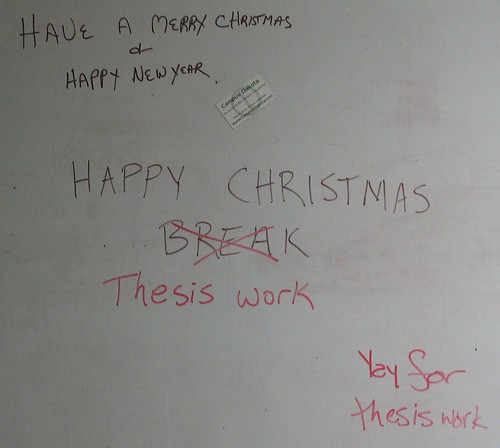
Basement whiteboard

One of the projects I want to get mostly completed by the time I return in January is to produce two graphics based on literature and museum data concerning my family-level taxon of study. The first of these will be a range chart of the fossil and modern genera (if not species…we’ll see), the second a map showing where all of these taxa can be found. To the commonfolk (i.e., anyone who has never tried this before) this might seem easy, but it’s really going to take a lot of digging through old papers, searching PDFs, and racking up a heck of a list for interlibrary loan next semester. I rediscovered earlier this week that although there may be a lot of information out there on my taxon, some authors didn’t do the best job of organizing what they knew.

Now, you might ask me why I want to use a great deal of my “break” time to do research. The first reason is that I would like to graduate somewhat soon, and the time for, well, wasting time is over. The second reason is something I had to come up with myself for motivational purposes: I want to help people understand things, and to do that I need to be able to make good graphics.

“Infographics” have been the hot new thing for a couple years now, and Tufte will tell you over and over again that you need to include what data are needed and eliminate the stuff that doesn’t matter. I would also argue that things need to be aesthetically pleasing to be educational, something to which I attribute the use of such soothing colors in introductory textbook diagrams. The point I am trying to make is that I need practice in this area, and I might as well practice now, at the beginning of my dissertation, than at the end when all I will want to do is hand-scribble a diagram, scan it, and call it good enough to hand in.

Optimally, my goal is to make these figures (my range diagram and global distribution map) not only good enough to include in a peer-reviewed journal article but good enough to print out as posters and hang on the wall! This is the goal toward which I am striving: I want someone in a similar research area to be able to use my work as a visual reference, and I want someone who has no clue about my research area to be able to look at it and say “oh yeah, I see how this can be useful.” For a great example, see the “Unionoida cum Grano Salis” poster from the Mussel Project.

Goals like “aesthetically pleasing” and “understandable” are intangible and hard to quantify, but that’s also not the entire point–sure, I’ll be happy to get as close as I can, but my real reason is the second motivation I listed above. If I can picture the future where I’m done with the figures, they look good, and I publish them so others can use them, it makes the drudgery of collating occurrence data that much more bearable–and if that is what gets good science done, let’s do it.

First winter training ride 2010/2011

[EDIT: My winter riding setup has changed quite a bit since this post.  The basics are there, but I’ve upgraded pretty much all of my clothing, requiring me to wear fewer, lighter layers.  I’ve replaced the bicycle (won a Pugsley frame at a race), upgraded the lighting, and gone to flat pedals with Power Grips combined with Muck boots for my feet.  2014-02-05]

I just got back a while ago (:-P) from my first “official” training ride of the winter season. It snowed the weekend before Thanksgiving, but I was returning from the Smithsonian and missed out on the freshie powder, then was busy all week aside from commuting. This evening I finished what I was doing in time to get some real training in.

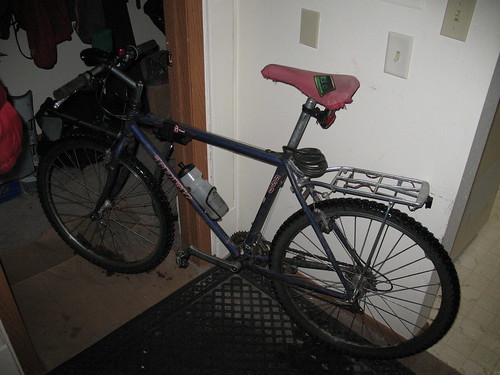
IMG_8931
(All You Haters Stud My Tires)

The temperature when I returned (a little before 7 PM) was 17 F (-8 C), so it’s balmy by Grand Forks standards (or it will be by March!). There was an 11 MPH (17 km/hr) breeze from the north, but it definitely (to my out-of-shape body) felt like a lot more than that. I did the pedestrian bridge loop (to north bridge to south bridge and back) on my mountain bike, following the Greenway path. The path is nicely plowed for the most part, so much so that once my light died I could still see well enough to not endo over any piles of snow kicked up by the snowmobiles (the clear sky may have helped in this regard; nothing like following a black ribbon through a white wilderness).

As I said, the wind being from the north I got a bit of a workout, followed by a long period of speed, followed by my realization that I had forgotten how much of a workout I’d had at first, once I got to turn back into the wind. The weather was nice, and I think I dressed appropriately, which is always something of a challenge for me. I tend to run hot, which up until recently has resulted in me winding up drenched by the time I get to school since I wear a down jacket. I finally bought a clip-on pannier/shopping bag that I can throw my messenger bag into and not have to carry it on my back, so it’s much easier to regulate my temperature while commuting.

Anyway, back to tonight: the image below shows what I was wearing, with a list in case people are interested. I was warm enough with the tailwind, but the headwind sections were somewhat chilly on the knees and arms. I tried out vapor barriers for my feet for the first time since I have chronically cold toes in the winter; they may have worked, or it may have been too warm for me to feel the difference. Any time I can step off the bike and not feel like I’m standing on two frozen lumps of flesh is a good day.

IMG_8930
(All You Haters Wash My Shorts)

“RED” snowboarding helmet (from Play It Again Sports)
Smith goggles and neckwarmer (from Ali!)
bike shorts from inside baggy mtb shorts
Teko socks from END-AR 2009
plastic bags from phonebooks
cheap Nike mtb shoes
wool mittens (knitted by Mum) inside Swedish mitts from Midwest Mountaineering
North Face fleece (from Ali’s parents)
Cloudveil pants (from Ali)
Under Armour coldgear shirt (from a guy I ran with at SLU)

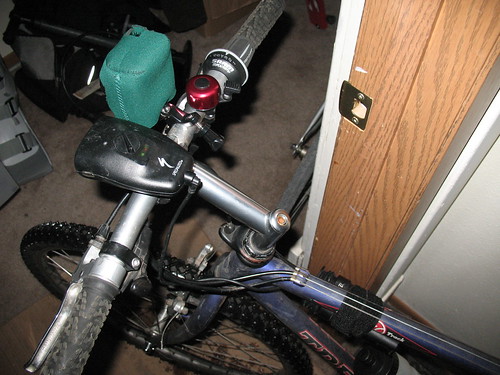
My other equipment could use an upgrade (maybe someone could b[u]y me this?), especially my front lighting system. I bought this light when I first got my mountain bike in eighth grade (thankfully the frame has proven large enough!). It runs a single incandescent bulb, I have no idea what the candlepower is, and uses 4 D batteries. It also seems to be having a lot of trouble in the cold this year 🙁

IMG_8932
(All You Haters Velcro My Batteries)

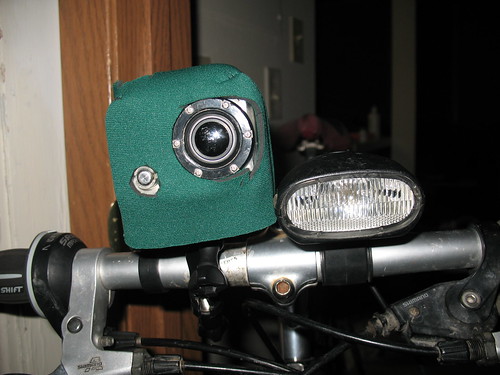
Since I’m trying to limit the whole blog post production time (BPPT) to a half-hour or less, I’ll only throw up one more photo of my new camera sweater. I’m not sure it works to keep things warm so the batteries last longer, but my buddy Mario (now Cat 2 road, congrats!) uses a similar setup for his power meter, and considering he’s an electrical engineer, it can’t have deleterious effects. I’ve been taking some decent winter commuting videos, so hopefully they’ll make it up eventually.

IMG_8934
(All You Haters Sweater My Camera)

Happy riding!

Ride distance: 16.2 km
Ride time: 45:11
Average speed: 21 km/hr

Trouble-Free Upgrading Between Opera Nightly Builds in Mac OS 10.6

(If you can’t tell from the title, I’ve been reading too much Lifehacker lately.)

As alluded to before, I’ve been using Opera for a month or so now because Camino decided it was going to suck down all my CPU. Since only the nightly build at the time had the feature I wanted (bookmark bar, works well so far), I was forced to travel into “the land of no automatic updates.” Fortunately, I figured out how to keep all of my settings, bookmarks, and even open tabs when upgrading. Note that these steps may not be necessary, since everything might end up hunky-dory all by itself.

Steps:
1. You’re probably getting your nightly builds from here. Why they use a blog (with anonymous commenting disabled, no less) for getting feedback on builds is beyond me. In any case, you should download the nightly you want to use.
2. Back up your bookmarks and your ~/Library/Preferences/Opera Preferences * folder just in case. You can also move your current Opera application bundle out of Applications and onto the desktop just in case.
3. Install the new version by opening the DMG and dragging the application bundle to your Applications directory. Don’t start the browser yet.
4. Copy the files you backed up from your Opera Preferences folder into the most recent Opera Preferences folder (there might be a version change which changes the folder name; just today I went from 10.7 to 11.0 on the folder name even though I’m using the last build of 10.
5. Start Opera (the new version). Hope things work.

Hope this helps somebody, or at the very least sets them on the right track.

Life as a Race/Event Coordinator

I was recently (last month) elected to be the Race/Event Coordinator for the UND Cycling Club. This is a position I’ve more-or-less held in some capacity for the past few years, since I’ve been trying to get more events happening ever since I got hooked up with the club back in 2008. Now that I can someday put this on my resume (ha!), I’m taking it more seriously, but at this point I’m receiving more help than opposition than any time in the past.

I intend to add “event coordinating” to the list of things I blog about here. Over the next year you will be subjected to the problems I encounter, the triumphs of successfully navigated paperwork, and hopefully even some good feedback about what else can be done in Grand Forks for this organization and others.

One of my inspirations in this pursuit is Andy Magness, director of END Racing, choreographer of the only adventure racing in the state, and top-notch yoga instructor. If I can get to the point where I can orchestrate an event with half the participants, half the sponsors, half the press, and half the general excitement surrounding it of any of the events Andy has organized over the last few years, I’ll be flying high.

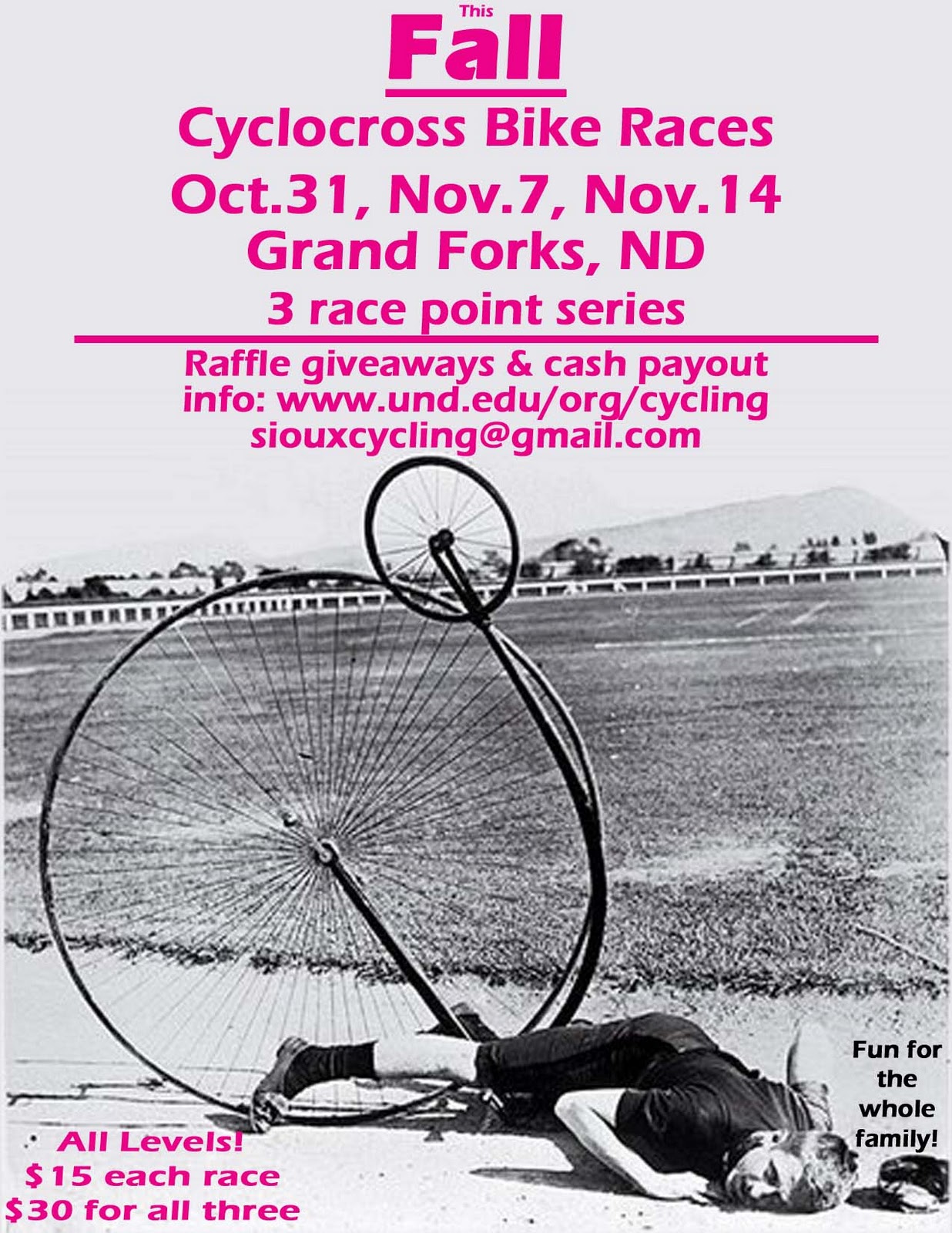
As someone who is naturally not outgoing, event coordinating is a big deal to me for that reason: I have to interact with people, I have to know what’s going on, and I have to think of things nobody else does, answer questions that nobody would ever come up with, and do it all with volunteers who would much rather be racing than volunteering (but we’re working on that this year; I’m committed to this role, even if it means I don’t get to participate in the ‘cross series [beginning Halloween in Riverside Park], the icebike series [announcement coming soon!], or even another collegiate road race weekend).

Most importantly, I need to be able to take the (sometimes nebulous) ideas presented by club members and turn them into a workable event. The best mind we’ve had for this is Dave Cardarelli, who will finally be graduating this December. Whether we’ve been organizing UND’s 2010 NCCCC road race weekend (complete with conference criterium championships), alleycat races that aren’t boring, or Grand Forks’ first ever (?) icebike race, Dave has either known what to do or shouted the rest of us down when we disagreed, which generally amounts to the same thing. Now that I’ve got this role on my shoulders, I hope I can measure up.

So far this fall I’ve been in contact with more people than ever to get some last-minute fall events into place and think about the future:

  • We’re starting a three-race cyclocross series (UND’s Fall Classic, to be expanded next year) on Halloween. Instrumental in the planning of this race so far have been my geology colleague Ted Bibby as well as Dave; so much so that I have yet to visit they race course they’ve supposedly devised, even though I’ve delivered a map to the city with our request for a special events permit.
  • For the long term, I’ve been working with riders in Fargo, Sioux Falls, and Winnipeg to organize a winter icebike series next February, as well as keeping in contact with Andy Magness to make sure we won’t interfere with END-IT (which as scheduled stands to be the light at the end of the tunnel of a month of winter racing if all goes to plan).
  • It hasn’t been nailed down yet whether we’ll be hosting “Too Flat, Too Furious” again next spring, but if our roster expands as much as I hope it will, we shouldn’t have a reason not to (more riders, in my mind, means a larger volunteer pool and more people invested in making sure the event goes off without a hitch). We’ll be talking about this down the road as people start dropping like flies around January.
  • We failed to organize a late summer mountain bike series this year (although getting a ‘cross series in before the snow is a nice bonus), but I hope to get it rolling for sure in mid-August: six weeks of mountain bike racing at Turtle River State Park followed by six weeks of cyclocross (which could alternate between TRSP and the Grand Forks Greenway, to say nothing of finding a friendly farmer who will let us use a cornfield).
  • Beyond? Well, let’s not get ahead of ourselves 🙂

As a final note, this isn’t about me: it’s about the club and what we can do for people in Grand Forks. Cycling, running, and even adventure racing events have been on the rise since I moved here in January 2006. I intend to make this trend continue, so if you have any ideas for events, improving events, or collaborating, get in touch.